
Murphy Music Press / MURPHY / W-1246
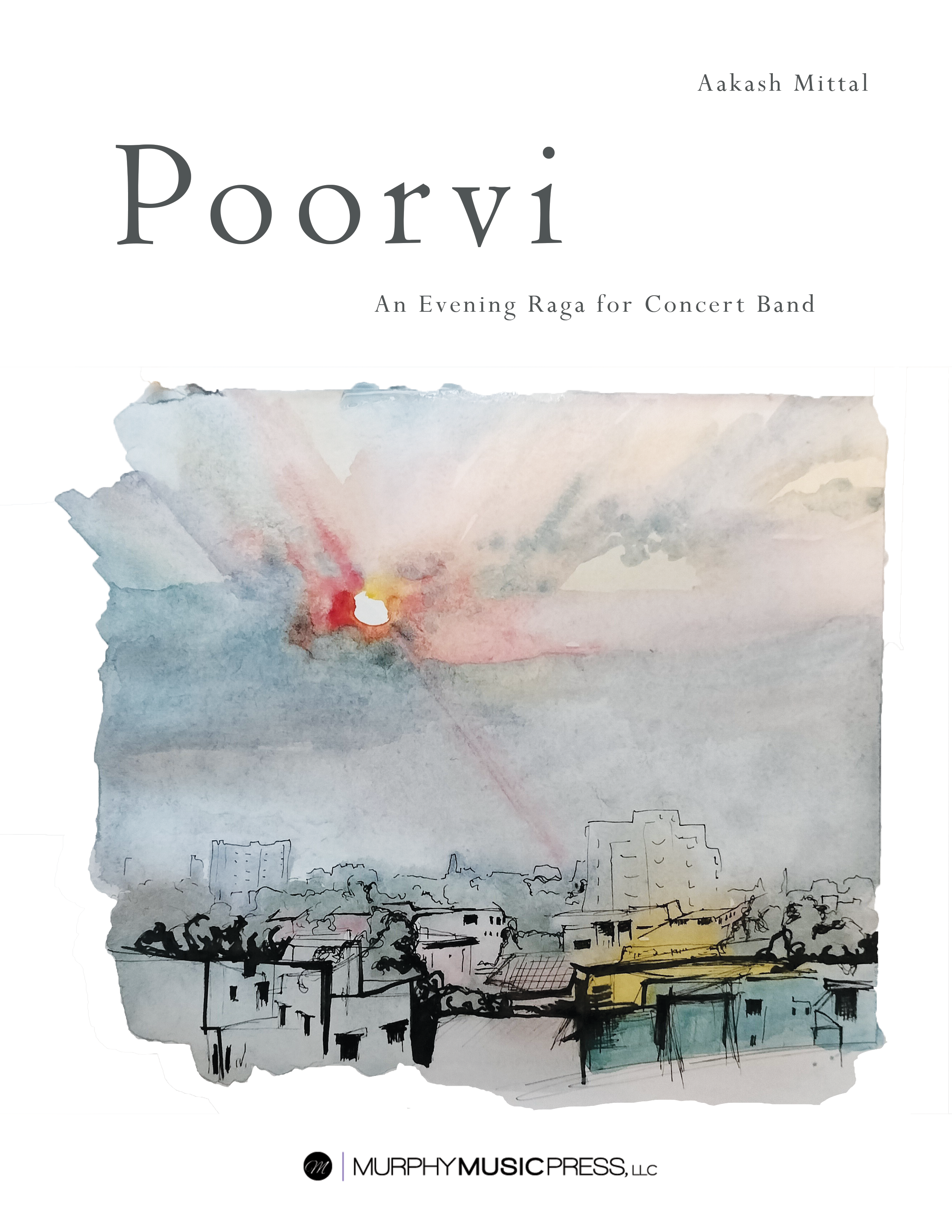
Poorvi: An Evening Raga
Aakash Mittal
Scroll down for Related Items listings.
The sounds of bells, gongs and struck metal objects will forever remind me of my time studying music in India. From rituals in Pushkar, Rajasthan to Kolkata’s Durga Pooja festival, to the bell-laden cows passing on the road, metallic timbres were part of the soundscape. The opening metallic sounds of Poorvi: An Evening Raga for Concert Band invokes the improvised rhythms of India’s street music that I regularly encountered.
As the sound of bells establishes the color of this piece, clarinets or other high woodwinds emerge with a single unison melody. This phrase is a melody central to raag Poorvi. Raag Poorvi is one of thousands of ragas, a highly detailed musical system originating in South Asia. A few measures later this central phrase, called the raag chalan, is restated and varied by woodwinds as the metallic sounds continue. Suddenly, trumpets and saxophones enter, playing a third variation on the raag chalan. After percussion enters dramatically, the piece begins to move forward at a faster tempo.
It is nearly impossible to express the full nature of a raga within concert band instrumentation. One challenge is that each raga has a unique approach to gliding between specific notes. This glide, called meend, changes speed, inflection, and timbre depending on the raga. This technique is not sight-readable as it requires many years of focused listening and practice. Additionally, raga music is typically small ensemble music. A traditional concert features a solo vocalist or instrumentalist that brings the raga to life by performing highly structured improvisation and a series of fixed compositions. The soloist is often accompanied by a number of instrumentalists. Tanpura players establish a drone of the root note, a tabla player expresses the rhythmic cycle, and a harmonium or sarangi player reflects the soloist with melodic accompaniment. Despite these differences in technique and instrumentation, I believe there is a universality to raga music that allows it to function as the seed material for melody, orchestration, and harmony within the wind ensemble medium.
As a composer exploring the sonic universes of raga music and concert band instrumentation, I ask myself, what experience do I want to share with you, the listener, by the end of this piece. From a technical standpoint, I want to introduce you to raag Poorvi, whose essential melody, the raag chalan, is stated four times throughout the work. The center of the piece features a traditional composition called khayal, which is stated three times across various instruments in the band. I hope you leave the concert humming these melodies. I also want to share with you the sonic experience of cultural hybridity. In addition to the sound of bells, I often encountered breakbeats in night clubs, backbeats in ensemble rehearsals, and sounds that intentionally bridge the gap between modernity and tradition, during my time studying music in India. I hope the sounds of Poorvi: An Evening Raga for Concert Band invoke this sonic diversity and shine a light on our collective journey.

Level: 3


Related Items
| Publisher | Title | Composer / Arranger | Voicing | SKU | Price | QTY |
|---|---|---|---|---|---|---|
| Murphy Music Press | Poorvi: An Evening Raga (Score) | Aakash Mittal | W-1246A | 55.00 |